
Why Scary Headlines and Strong Returns Can Coexist – and What Your Brain Gets Wrong About Both
Q2 | June 2026

Topic: Investments
June 2, 2026
Image used with permission: iStock/PeopleImages
Why Scary Headlines and Strong Returns Can Coexist – and What Your Brain Gets Wrong About Both
Q2 | June 2026
The positive feedback from clients after seeing their first quarter returns was remarkable. Reactions like that could only come from a pleasant surprise, which only meant they were expecting something less pleasant. And it’s no wonder why.
If a client went to sleep on December 31 and woke up on March 31 and the first thing they did was to read the first quarter headlines, their head might have spun and they’d likely have had to swallow hard before opening their quarter-end report:
January 3: “U.S. Captures Venezuelan President Nicolas Maduro” (CBC)
January 11: “Federal prosecutors open criminal investigation into the Fed and Jerome Powell” (CNN)
January 20: Carney urges countries to call out ‘hegemons’ and bullies in striking WEF speech (NP)
Feb 20: Supreme Court rules that Trump’s sweeping emergency tariffs are illegal (CNN)
National Post: Feb 28 U.S., Israel launch attacks on Iran as Trump urges uprising (NP)
March 8: Oil jumps to 2022 high on Iran war, falls after close as Russia sanctions in doubt (Reuters)
What the Scoreboard Actually Said
The reality upon seeing their first quarter numbers, however, would have been more delight than horror:
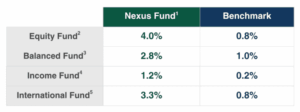
Resisting the temptation to jump to conclusions, particularly negative ones, has to do with controlling heuristics, an intuitive decision-making process that the brain uses as a shortcut, or rule of thumb which prioritizes efficiency over logic. Unfortunately, “these rules of thumb… produce systematic biases or predictable errors in judgment.” (Alejandro Hortal-Sánchez, The Conversation, 24 Mar. 2026)
Fast Brain, Slow Brain – and Why it Matters for Your Portfolio
Heuristics, most notably studied by psychologists Daniel Kahneman and Amos Tversky, and explained in detail in Kahneman’s book Thinking Fast and Slow, is worth understanding, especially in this volatile day and age. In his book, Kahneman describes two modes of thinking. System 1 is fast, automatic, and emotional – it’s the part of your brain that flinches at a loud noise or feels a knot in your stomach reading a frightening headline. It’s extraordinarily useful for immediate threats. System 2 is slow, deliberate, and logical – it’s the part that does the actual math, weighs evidence, and forms reasoned conclusions. The problem is that System 2 requires effort, and our brains are fundamentally lazy in the sense that they prefer the efficient shortcut of System 1 whenever possible. When markets are volatile and headlines are alarming, System 1 is loudest precisely when we need System 2 the most.
Your Brain is Working Against You – By Design
The most vivid recent example is March 2020. As COVID-19 triggered the fastest market decline in history, a wave of investors – acting on perfectly rational-feeling instincts – sold out of equities to stop the bleeding. The headlines justified it. The feeling was overwhelming. And yet, the S&P 500 bottomed on March 23 and recovered its pre-pandemic highs by August, just five months later. Investors who acted on their heuristic and fled to cash locked in their losses and missed one of the sharpest recoveries in market history. Their System 1 brains were doing exactly what they were designed to do.
This presents a challenge to our Stone Age brains trying to process the plethora of data being hurled at us in the Digital Age, especially when most of it has a negative bias.
It’s human nature. “The brains of humans and other animals contain a mechanism that is designed to give priority to bad news. By shaving a few hundredths of a second from the time needed to detect a predator, this circuit improves the animal’s odds of living long enough to reproduce.”6
The Media Knows it Too
Unfortunately, there is no corollary for positive news. As early as the 1890s, Wiliam Randolph Hearst was quoted saying “if it bleeds, it leads”7. That journalist’s dilemma remains alive and well today and there is no shortage of gas for its engine. Research consistently shows that negative headlines generate significantly more clicks, shares, and engagement than positive ones – and the platforms that deliver our news have learned this lesson well. Social media algorithms are optimized for engagement, not accuracy or balance, which means fear-inducing content is systematically amplified over reassuring content, regardless of its relative importance. This isn’t an accident or an editorial oversight. It’s a business model. The negativity bias that evolution wired into our brains is, in the Digital Age, being deliberately exploited. Knowing that doesn’t make us immune to it, but it should make us more suspicious of our own instinctive reactions to the news cycle.
So What to Do About the Urge to Panic?
The good news is that simply knowing this distinction exists is one of the most effective ways to trigger the shift. Pausing to ask “am I reacting or reasoning?” is often enough to engage the slower, more reliable system.
So it’s up to us to train our brains to use Kahneman’s System 2 of thinking slow, and forming conclusions based on data and hard evidence. Thankfully, there are some tricks we can use.
Over the years, Nexus has written many blogs and articles about the psychology of investing and offered tips on how to frame the pessimism coming at us, seemingly from a fire hose. I offer some excerpts and links below. Although some are a bit dated, the messages remain the same.
John Stevenson: Free and open economies have a remarkable ability to adapt and turn challenges into opportunities. (The Atlantic’s David Brooks) believes that entrepreneurial energies evident in the world around us will allow our society to deal with most of (these) existential challenges. Free and open economies have a remarkable ability to adapt and turn challenges into opportunities. He argues that a society declines when it loses energy. Canada and the U.S. are filled with energy.
Geoff Gouinlock: Although a bit dry, one finishes (The Rational Optimist) armed with a renewed belief that today’s all-knowing pundits who forecast an unavoidable gloomy future, preoccupied with managing with less, are off the mark. For investors looking to build wealth and a comfortable retirement, it’s welcome news.
Devin Crago: What each investor needs is a financial plan containing strategies to achieve their long-term goals. Although it’s never easy, it is important to ignore the noise of the market and concentrate on the ingredients for long-term success:
- Invest in high quality businesses…
- …and buy those businesses at good prices
- Intelligently diversify your portfolio
- Manage risk
- Apply a strategic asset allocation mix that addresses your specific needs
Also Devin: “If you are always more unhappy when you get bad news than you are happy when you get good news, that implies that, on average, looking up your portfolio is painful,” says Michaela Pagel, once-Columbia, now Washington University professor. “Most people, if forced to look at their portfolio every single day, would make a very poor investment decision – they would find it so painful that they would not invest anything.” The solution? Check less often.
Looking Ahead – With the Right Lens
As we move into the back half of 2026, the headlines will not get quieter. Tariff negotiations, geopolitical tension, and an unusual degree of policy uncertainty in the U.S. will continue to generate noise. The temptation to read each development as a turning point – a reason to act, reposition, or retreat – will be constant. But the lesson of Q1 is not that nothing matters. It’s that the gap between what feels catastrophic in real time and what actually registers in long-term portfolio performance is almost always wider than our instincts suggest. The task isn’t to ignore the world. It’s to observe it through the slower, more disciplined lens that a sound wealth plan was built to provide. The plan was made by a System 2 brain, on a calm day, with full information. Trust it.
And if you’re having trouble, call your Nexus Wealth Manager. Clients may think about the value Nexus provides them in terms of measurable factors, such as solid investment performance, tax savings, and other quantifiable benefits they obtain from our thoughtful wealth planning service. However, perhaps – just perhaps – the biggest value to the client is that System 2 is our default setting, and being critical, diligent, and deliberate in particularly challenging times is when we prove our worth. It is during those down markets that using System 2 is of utmost importance. As now-retired colleague Fergus Gould used to say, “we fundamentally know seatbelts and airbags have value, but we don’t know their true worth until we need them.”
[1] All Nexus returns are compound annual average, time-weighted, total rates measured in C$ and calculated after deducting such direct and indirect costs as applicable withholding taxes, trading commissions, custody fees and other fund/account expenses, but without deducting Nexus’s management fees (which are charged to client accounts and vary by client). Returns for market indices and benchmarks are presented on the same basis, but without any such deductions. For more on benchmarks: https://tinyurl.com/NexusOnBenchmarks. Past performance is not indicative of future results.
[2] Equity Fund market benchmark is 5% FTSE Canada 91 Day T-Bill Index, 50% TSX, and 45% S&P 500 (in C$); rebalanced monthly.
[3] Balanced Fund market benchmark is 5% FTSE Canada 91 Day T-Bill Index, 30% FTSE Canada Universe Bond Index, 40% TSX, and 25% S&P 500 (in C$); rebalanced monthly.
[4] Income Fund market benchmark is the FTSE Canada Universe Bond Index. Note that in addition to bonds, up to 20% of the Income Fund portfolio may be invested in equity securities.
[5] International Equity Fund market benchmark is 75% MSCI EAFE and 25% MSCI Emerging Markets indices (both in C$); rebalanced monthly.
[6] Daniel Kahneman, Thinking, Fast and Slow (2011), 301.
[7] Jillian Reis, “If It Bleeds, It Leads: Crime Reporting,” International Council for Media Literacy, 2023, https://ic4ml.org/blogs/if-it-bleeds-it-leads-crime-reporting/.