
The Hidden Costs of Divorce: What Couples Don’t Budget For
Q3 | September 2026

Topic: Wealth Planning
September 1, 2026
The Hidden Costs of Divorce: What Couples Don’t Budget For
Q3 | September 2026
“I’m getting a divorce.” The words alone evoke an emotional reaction: perhaps sad, or relieved, angry, reflective, even numb. But along with the emotional rollercoaster, comes a significant financial transition. When you’re divorcing your partner, you’re also disentangling a financial partnership.
No one goes into a marriage expecting to see it end. But life circumstances and relationships can change over time, often unexpectedly. About 38% of marriages in Canada end in divorce, and for many, divorce can result in an immediate 50% drop in net worth. Understanding how a divorce might affect your financial situation will help ensure that, if you do separate, you’ll be in the strongest possible position for long-term financial security.
Using a couple we’ll call Heather and David as our example, let’s first look at what most couples assume the costs will be when divorce seems inevitable.
Expected Costs of Divorce
Heather and David share substantial assets, which gives them both confidence that they can go their separate ways and maintain their lifestyle and financial security. Their assets include their home and vacation property; they each own a car, both are employed, and their investments have grown in value over the years.
Once they begin divorce proceedings, Heather and David assume that their biggest costs will be legal fees. The amount of these fees will depend on the issues involved and the approach Heather and David take:
- Uncontested divorce: If they can agree ahead of time on the division of property, parenting scheduling, and support, legal fees will likely be much lower.
- Contested divorce: Heather and David are prepared for this scenario as well. If there are complex issues to resolve and one or both do not feel that collaboration is possible, fees will be much higher. Legal fees can increase dramatically when there are multiple motions or a trial. When it comes to divorce proceedings, the adage “the more you fight, the more you pay” is true.
Most couples will also require the expertise of an accountant. Whether they share one accountant or each retain their own, an accountant can help assess each spouse’s income, identify the tax implications of dividing assets, and estimate the after-tax value of a proposed settlement.
Given the above, Heather and David figure that the process will be manageable from a financial point of view. So, what are they missing?
Unexpected or ‘Hidden’ Costs of Divorce
Beyond the legal and accounting “out-of-pocket” expenses, there are “hidden” or unexpected costs for which couples are often unprepared.
Most hidden costs associated with divorce relate to the process of dividing assets. In Ontario, the division of property is governed by the Family Law Act through a system known as the equalization of net family property. Net family property generally includes the after-tax value of all assets owned at the date of separation, less debts and certain other deductions.
To put the spouses on an equal footing after divorce, the spouse who owns assets with the greatest total after-tax value makes a payment to the other equal to the amount by which such value exceeds half of the net family property. Depending on the circumstances, certain assets, such as some inheritances and gifts, may be excluded from net family property. (The matrimonial home is treated differently from other assets. Even if the home was owned by one spouse before the marriage or is registered only in one spouse’s name, its value is generally shared between the spouses under Ontario law).
Here are some of the itemized costs, and the example of Heather and David for each to frame them out in a realistic way:
1. Professional Valuation Costs
Before property can be divided, each spouse’s assets must be valued as part of the equalization process. Assets like bank deposits and publicly traded securities are easy to value. Others, like real estate, a private investment, or an interest in a business, require professional expertise. Depending on the complexity of the couple’s finances, this step may require input from several professionals.
Professional valuations can become one of the largest unexpected expenses in a divorce. In some cases, couples agree to use a single independent expert. In more contested situations, however, each spouse may retain separate valuation professionals, which can significantly increase both the cost and time needed to reach a settlement.
Bottom line:
Professional valuation fees can add up – particularly if spouses retain separate experts.
What you can do:
- Budget for these costs early.
- Where appropriate, consider using jointly retained independent experts.
Heather & David’s Situation
Heather assumed valuing their assets would simply involve collecting account statements. Instead, they needed an appraisal for the family home and cottage, a valuation of David’s private interest in his brother’s company, and an actuarial valuation of Heather’s defined benefit pension plan. The professional fees quickly added up, before either lawyer had begun negotiating the settlement.
2. Getting the Valuation Date Right
For the equalization process, each asset and liability is assigned a value as of a specific valuation date. Under Ontario law, this is generally the date on which the spouses separate. Think of the valuation date as a snapshot of your family’s financial position on the day you separated.
Establishing and documenting the correct separation date is critical. Because it determines the value of all assets and liabilities used in the equalization calculation, keeping records and obtaining legal advice early can help reduce the risk of costly disputes over asset values.
Bottom line:
A disputed or incorrect valuation date can lead to costly legal and professional fees.
What you can do:
- Keep clear records of when you separated.
- Speak with your lawyer early if the separation date may be disputed.
Heather & David’s Situation
Heather moved into the basement in early March after the relationship broke down, but the couple continued living under the same roof until David found a new apartment in June. Months later, they disagreed about when they had actually separated. Because investment markets and real estate values had changed during that time, determining the correct valuation date became an expensive legal issue.
3. Missing Financial Information
Many people don’t fully understand everything they own – or owe – until they begin the divorce process. Missing information can delay negotiations, increase professional fees, and result in an unfair settlement.
Bottom line:
An incomplete financial picture can delay your settlement and increase costs.
What you can do:
- Gather copies of financial documents and account statements early.
- Understand all family assets and liabilities before negotiating a settlement.
Heather & David’s Situation
As Heather’s and David’s finances are being reviewed, Heather discovers that David had drawn heavily on a joint line of credit without her knowledge. Heather’s name is on the line of credit, so she’s legally responsible for the debt alongside David, despite having no knowledge of the borrowing. Months of additional document requests and professional review were required before they had a complete picture of the family’s finances.
4. Hidden Tax Costs
Taxes can significantly affect the true value of what each spouse receives. The equalization payment by one spouse to the other is calculated using the after-tax values of all assets included in net family property, whether or not an asset is actually liquidated so that the resulting taxes become due and payable. The pre-tax values reported on account statements are only a starting point.
A non-comprehensive breakdown of the taxes after a divorce includes:
- Capital gains taxes: The sale or transfer of investment assets, pensions and other property (except for the principal residence) can result in significant capital gains tax – in other words, an unexpected cost that reduces the value of your overall assets.
- Not all accounts are worth the same: RRSPs come with a future tax bill; TFSAs don’t. Both parties need to ensure that the final equalization payment accounts for these differences in tax treatment.
- Tax breaks that disappear after divorce: Post-divorce, spouses will lose access to tax-efficient strategies like pension income splitting and spousal RRSP contributions.
- Spousal support you receive is taxable: When negotiating support, focus on how much you’ll receive after tax, not just the gross monthly payment.
Bottom line:
The value of an asset may be quite different in divorce than the number appearing on an account statement.
What you can do:
Make sure you understand the after-tax value of what you’re receiving by working with your accountant and wealth manager before agreeing to a settlement.
Heather & David’s Situation
At first glance, Heather believed she was receiving more because she was keeping a larger investment account. What she hadn’t considered was that the bulk of her investments consisted of her RRSP, which was discounted by about half to reflect that every future withdrawal would be fully taxable as income. Once taxes were considered, the settlement looked very different.
The Costs That Come Later
Finalizing a divorce can bring an enormous sense of relief. But while the legal process may be over, the financial impact often isn’t. Some costs appear immediately. Others don’t emerge until years later, when life inevitably changes.
A non-exhaustive list will likely include many of the following:
- Replacing family health coverage: One partner often relies on the other’s family health coverage, which vanishes upon divorce. This is an immediate hidden cost due to the significant expense of securing individual insurance.
- Replacing accommodations: While staying in the family home may feel like a win, the full cost of maintaining it must be taken into consideration in any support payment to keep up with property taxes, maintenance, and major repairs.
- Buying or renting a new home: Either can mean realtor fees, moving costs, furniture, and the ongoing expense of maintaining a second household. Even if both spouses’ incomes remain the same after divorce, they’ll be spread across two homes, each with their own everyday costs like utilities, property taxes, insurance, and maintenance. This can quickly put pressure on cash flow for one or both spouses.
- Children’s needs: These days, determining the amount of child support payments is relatively straightforward, but the needs of a child(ren) can change, and so can a parent’s mind! “Section 7 expenses”, known as extraordinary costs like daycare, competitive sports, braces, or post-secondary tuition, are shared separately from regular child support. As the needs of a child change, these costs can lead to unexpected outlays and, in some cases, renewed legal negotiations.
- Support payments can change: Even after a divorce is finalized, a change in circumstances – like the loss of a high-paying job or retirement – can trigger a “Motion to Change.” When this happens, both ex-spouses can find themselves in a second round of legal fees.
- Self-care: Divorce is ranked among life’s most stressful events. It’s likely that one or both ex-spouses will participate in some form of therapy or counselling, especially during high-conflict periods. In addition to the hourly rates, there may also be lost hours of paid work because of absences brought on by stress.
Bottom line
A divorce settlement isn’t the end. Planning ahead can help you avoid costly surprises and the need to return to court.
What you can do
- Develop a post-divorce cash flow plan before finalizing your settlement.
- Build flexibility into your divorce settlement whenever possible.
- Understand what life will cost after the divorce and consider how your financial needs may change over the next 5-10 years.
Heather & David’s Situation
When their separation agreement was finalized, the children were eight and ten, so future expenses like competitive hockey, braces, and university weren’t fully anticipated. Heather also needed to replace the family’s health coverage after the divorce. David’s later job loss meant the couple had to revisit their spousal support arrangement. Years later, thinking everything was settled, these unanticipated items and changing circumstances resulted in further disagreements, renewed negotiations, and additional legal fees.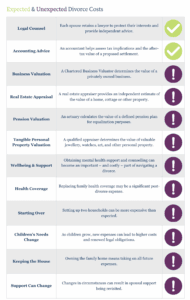
How Nexus Can Help
Identifying these hidden expenses helps bring “surprise costs” into the open, so divorcing couples have a clearer sense of what to expect. This information is not meant to discourage separation or divorce when it is the right decision. Rather, understanding both the “sticker price” and the hidden costs – and working with a supportive team – can help you move into the next chapter of your life with greater confidence.
You don’t have to navigate this process alone. At Nexus, our collaborative approach helps bring calm, clarity, and objective guidance to the uncertainty of “what happens next.” We help you understand the financial implications of divorce, plan for unexpected costs, and make informed decisions by working together with your team of professionals by:
- Considering the tax implications of different asset divisions to determine which combination of cash, investments, pensions, and property may best support your long-term financial security.
- Determining affordability across child support, spousal support, and living expenses, so you have a realistic view of post-divorce cash flow.
- Helping you avoid reactive decisions that can arise during an emotionally difficult time, such as selling a family cottage too quickly or agreeing to a settlement before fully understanding the long-term impact.
Divorce can feel overwhelming, especially when it means starting over after years – or decades – of shared finances. With the right team in place, you can understand your options, make decisions with greater confidence, and move forward with a clearer sense of what life after divorce may look like.
This article is the first in a series exploring the financial considerations surrounding separation and divorce. Stay tuned for future articles that will examine why women often experience a greater financial impact when a marriage ends and the steps they can take to protect their financial future.