
Investing While the Stock Market Rockets Upward
Q3 | July 2026

Topic: Investments
July 30, 2026
Investing While the Stock Market Rockets Upward
Q3 | July 2026
The level of the stock market typically reflects a combination of corporate earnings, economic prospects, and risk over time. Lately a disconnect has emerged. Several variables have caught our attention and while one lit match does not make a fire, multiple matches burning at the same time should not be ignored.
This is not a call for a market top, rather it is a reminder that we heed the warning signs.
Below, we outline why we think there is a widening gap between fundamentals and market prices, as well as some arguments for why conditions may persist. We close with why we believe our disciplined and active investment style and your tailored wealth plan will position you to participate prudently if markets continue upwards.
Rockets, Warnings, and Gravity
In artificial intelligence (AI), we are witnessing the largest single capital investment in history. This is happening alongside the largest expansion in space investment since the Apollo moon landings. AI and space exploration have captured the imagination of investors, the scientific community, and policymakers, as well as the popular zeitgeist.
In the spirit of the recent high-profile SpaceX initial public offering (IPO), let’s use a rocket analogy to describe the stock market:
Imagine a rocket blasting off with millions of pounds of thrust, accelerating out of the atmosphere and hurtling towards space at thousands of kilometres an hour. It is fueled by heavy investments in AI, economic and company fundamentals, and investor exuberance. Its massive payload consists of all the companies in the stock market. The higher the rocket goes, the more expensive the share prices become.
The rocket analogy over-simplifies market movements, but the visualization is compelling. Similarly, the gravitational pull of the earth is powerful, but the concept of an airborne RUD (rapid unscheduled disassembly) may also exaggerate the potential negative outcomes. Regardless, as the stock market soars to record heights, three warning lights flash on the control panel:
- The stock market appears expensive
- Unbridled exuberance is prevalent
- Underlying economic fundamentals remain fragile
It is possible that these turn out to be false alarms, but for now they have our attention.
The First Warning Sign: The Stock Market Appears Expensive
In its most simplistic form, we view the price (P) of a stock or index as its earnings (E) times its multiple (M). This is commonly referred to as a P/E multiple.
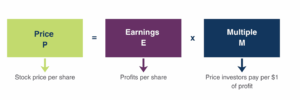
The E represents a reasonable estimate of cash earnings over the next year while the M reflects a subjective assessment of quality, growth, and risk. Earnings have been supported for years by fiscal and monetary stimulus, corporate AI investment, and a resilient economy. Multiples are elevated due to higher growth, expectations around AI, and optimism. Today, we see risk in both of the variables for the broader market.
Using the broad U.S. S&P 500 Index, the current multiple of 20.9x is well above the 30-year median of 16.8x. This indicates investors are feeling very confident about future prospects.
To smooth out the short-term noise of economic cycles, we also analyse the Cyclically Adjusted P/E ratio or CAPE. For context, the CAPE was developed by economists Robert Schiller and John Campbell. It uses rolling 10-year inflation-adjusted earnings to smooth out the short-term impact of economic cycles. On this measure, the multiple is currently 41.0x which is well above the 28.8x average over the last 30 years and the highest it has been since 1999. This supports our view that the stock market is expensive.
There are many other valuation metrics that suggest the market is expensive, but the simplicity of these metrics allows us to identify the source of risk. In a typical bull market, the M is the primary driver but in today’s case, both the E and M are elevated, which magnifies the potential effect. While these valuation metrics don’t necessarily predict an imminent market correction, they are a warning to exercise caution.
The Second Warning Sign: Unbridled Exuberance
For seasoned investors, the term “irrational exuberance” will sound familiar. In December 1996 the late U.S. Federal Reserve Chairman Alan Greenspan used the phrase in reference to “unduly escalated asset values” related to the inflating dot-com bubble. That period, like today, was characterized by historic IPOs, aggressive financing, and a “this time is different” mentality.
The IPO market has accelerated rapidly in 2026 and may even flirt with the record set in 2021 after recent and pending mega-cap equity raises. The June 2026 IPO of SpaceX (including xAI) set a record with US$75.0b raised at a $1.75t valuation. While the company has indicated a massive total addressable market (TAM) of US$28.5t (which rivals the current U.S. economy at ~US$32.0t), it relies on industries that do not yet exist. With profit expectations a long way off, a lot must go right for IPO investors to earn a compelling return.
Two other leading AI companies, OpenAI and Anthropic are reportedly set to come to the IPO market with valuations above $1.0t. While the projected growth rates for primary AI developers are impressive, neither company is reportedly profitable. Early indications of a price war in AI models threatens to further delay the path to profitability.
We have also observed the return of non-traditional financing mechanisms creeping into the ecosystem. This includes circular financing structures, where dominant technology hardware providers take equity stakes in their own customers (or lend significant credit), effectively funding the purchases of their own products. This boosts growth for both parties and magnifies risk.
Meanwhile, the rise of prediction markets has introduced a new way to express speculative behaviour. We adhere to a free-market philosophy, but these unregulated markets allow speculative, and sometimes manipulative, behaviour to proliferate. Betting on Bad Bunny’s wardrobe during the Superbowl doesn’t tend to impact much beyond the wager. However, we object when these bets begin to influence actions in regulated arenas such as the stock market.
As Mr. Greenspan’s 1996 speech reminds us, exuberance can last for years before reality sets in. Although his comments came after an exceptional run in the market, the NASDAQ subsequently gained over 400% before the peak in March 2000. Today, we can’t know if or when a market correction will occur, but generational capital raises paired with aggressive behaviours are warning signs that are worth heeding.
The Third Warning Sign: Economic Fundamentals Remain Fragile
Stock markets are naturally forward looking and optimistic, typically reflecting expectations of economic conditions and corporate earnings. Most of the time we would agree with the optimism. Today, North American economies are grappling with contradicting exogenous shocks like trade barriers, volatile energy prices, and AI-related spending.
Growth in Canada has been sluggish with the economy in a technical recession, defined as two consecutive quarters of contraction. The labour market appears resilient with reasonable net job creation, but the unemployment rate remains sticky and inflation persists. The ongoing review of the Canada-U.S.-Mexico (CUSMA) trade agreement adds uncertainty.
While economic growth in the U.S. is stronger than in Canada, estimates of a third to half of U.S. GDP growth is driven by AI infrastructure investment. The labour market, and specifically the unemployment rate, have been steady although job creation has been concentrated. Core inflation has persisted above trend for some time and has exacerbated the impact on low- and middle-income households.
These conditions are not dire, but they lack the underlying strength to support a stock market near all-time highs.
The Counterargument: What if the Warnings Are False?
A hallmark of a successful investor is open-mindedness. The phrase often attributed to the economist John Maynard Keynes rings true: “When the facts change, I change my mind. What do you do, sir?”.1
We hold our convictions tightly but actively seek new information to challenge our views. We are not blind to the things that may go right, so we reserve the right to change our minds.
The unprecedented scale of technology spending and associated corporate earnings growth rates is staggering and provides ample material for the skeptic. However, technological leaps can break old archetypes, and AI is arguably the most sophisticated advancement the world has seen. In the spirit of maintaining an open mind, here are some things that could go right to justify current market pricing:
- The AI models and datacentre investment may become financially successful.
- New industries, new markets, new business, and new jobs may be created.
- The resources required to build and operate AI datacentres may lessen, leading to higher margins.
- The widespread use of AI could lead to a global corporate efficiency boom.
- Some incumbents may adapt and harness the power of AI, fending off new competitors.
Many of these things are already progressing, so we are watching for the magnitude and longevity of the possible benefits.
Investing With Nexus
Returning to the rocket analogy, the yellow lights on the control panel are flashing but heeding the warning signs does not mean sitting on the sidelines. Rather, it means investing in quality stocks where risk is appropriately priced and side stepping the expensive and speculative areas – this is active investment management.
At Nexus, we prefer to keep it simple. We own high-quality companies, try not to pay too much for them, and remain intelligently diversified. Coupled with your comprehensive wealth plan and personalized asset allocation, our goal is to ensure you participate in the growth of carefully selected individual companies while avoiding the pitfalls of the broader market.
[1] While this phrase is commonly attributed to the economist John Maynard Keynes, it was first noted in 1970 by the economist Paul Samuelson and later attributed in 1978 by Mr. Samuelson to Mr. Keynes.